|
Stochastic evolutionary modelling
|
Motivation
Evolution of many real dynamical systems evidently reveals a stochastic behaviour that at first glance may even seem random. Numerous examples include temporal fluctuations in human gait dynamics, velocity and acceleration variations in seismic waveforms, the Earth's length-of-day fluctuations, and of course not to forget the most challenging phenomenon of market pricing. The point is that unlike deterministic models, it is often unclear how to derive stochastic equations of motion from first principles which would adequately describe the physical phenomena in question. Therefore, in order to predict the future evolution of a stochastic dynamical system, one usually takes an a priori chosen deterministic model and just supplies it with a stochastic term. Such an approach only imitates particular features of the real physical phenomenon and hence results in qualitatively improper simulation and inaccurate prediction of the future dynamics.
|
|
Goal
The goal of this project is, using first principles, to derive an equation of motion which would adequately describe the mechanisms of stochastic dynamics in complex systems. As an object of research we choose market pricing of primary financial instruments (e.g., stocks, commodities, etc.), because this phenomenon, due to its apparently noise-driven dynamics, is deemed to incapsulate the evolutionary mechanisms underlying all other stochastic phenomena.
|
|
Results
To achieve the goal, we involve a peculiar view on the origin of stochastic dynamics. This has allowed to analytically derive a probability equation of motion, whose properties are remarkably consistent with those of real financial instruments. These include:
|
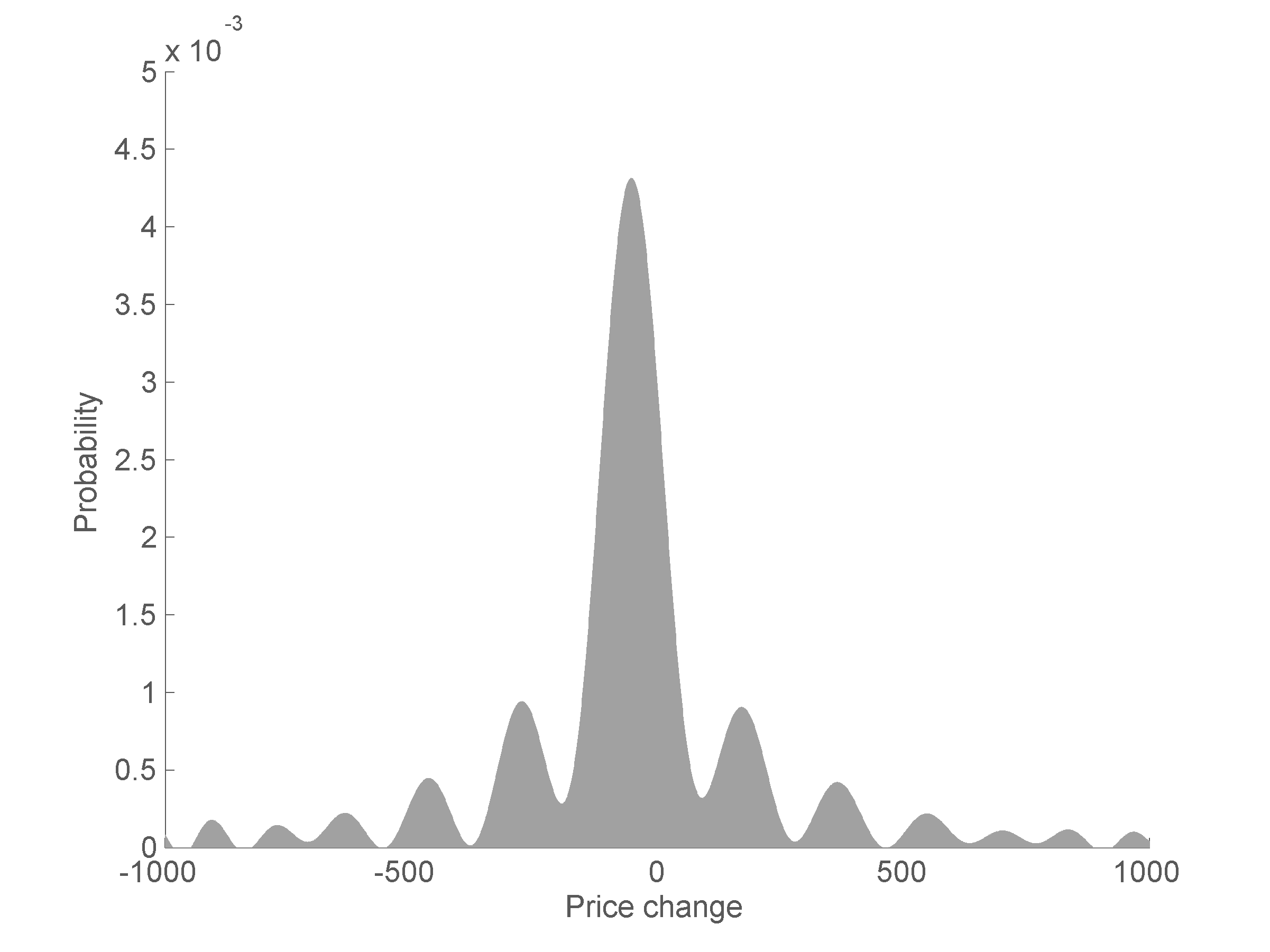
⌘ Fat tails The model's solution is a family of asymmetric wave-like probability distributions with fat tails.x An example is shown * on the right—the distribution's tails are evidently non-Gaussian.
|
|
* Hereinafter the solutions are shown smoothed: they demonstrate the general form concealing details to prevent reverse engineering.
|
|
⌘ Fat tails
|
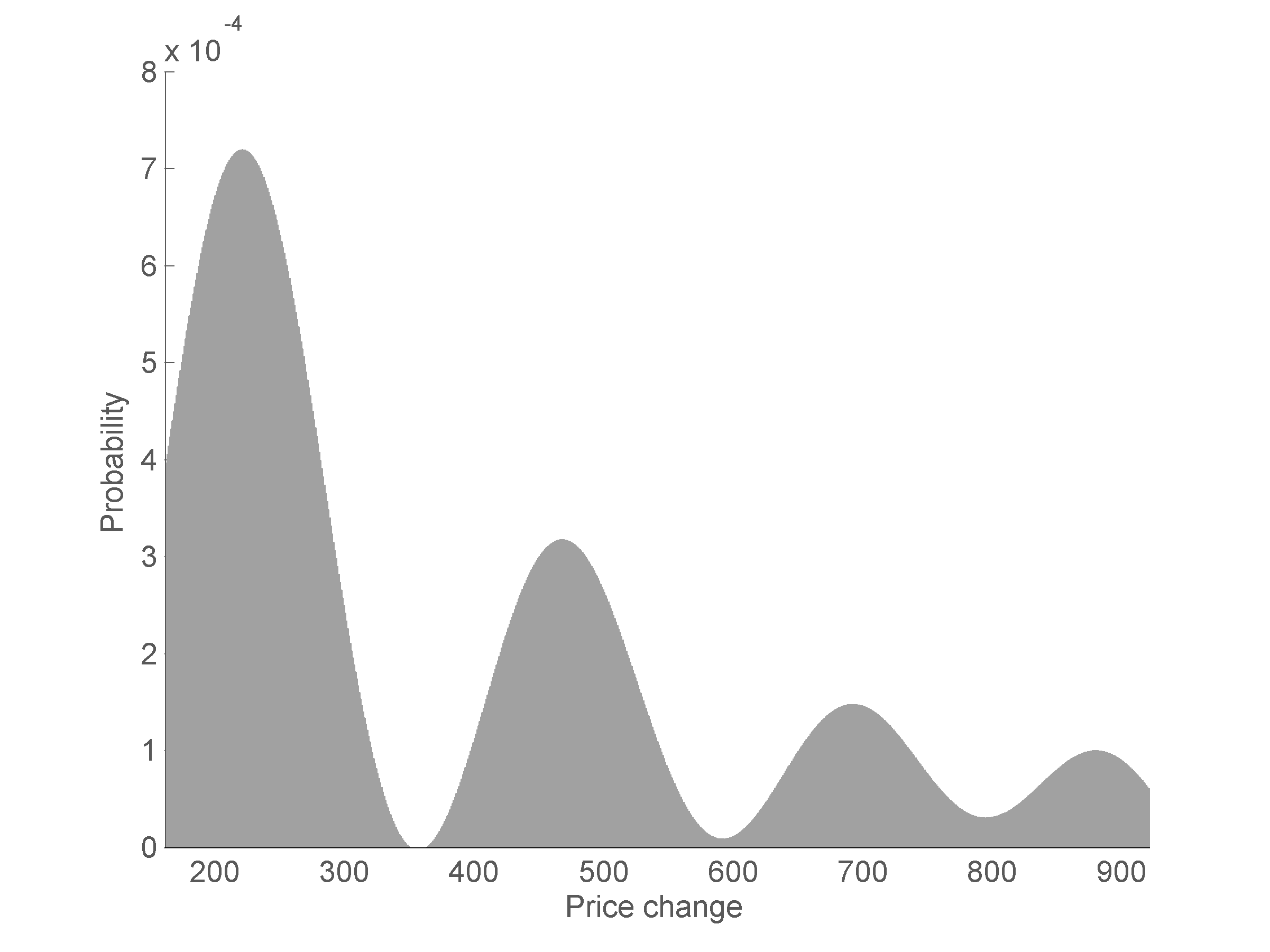
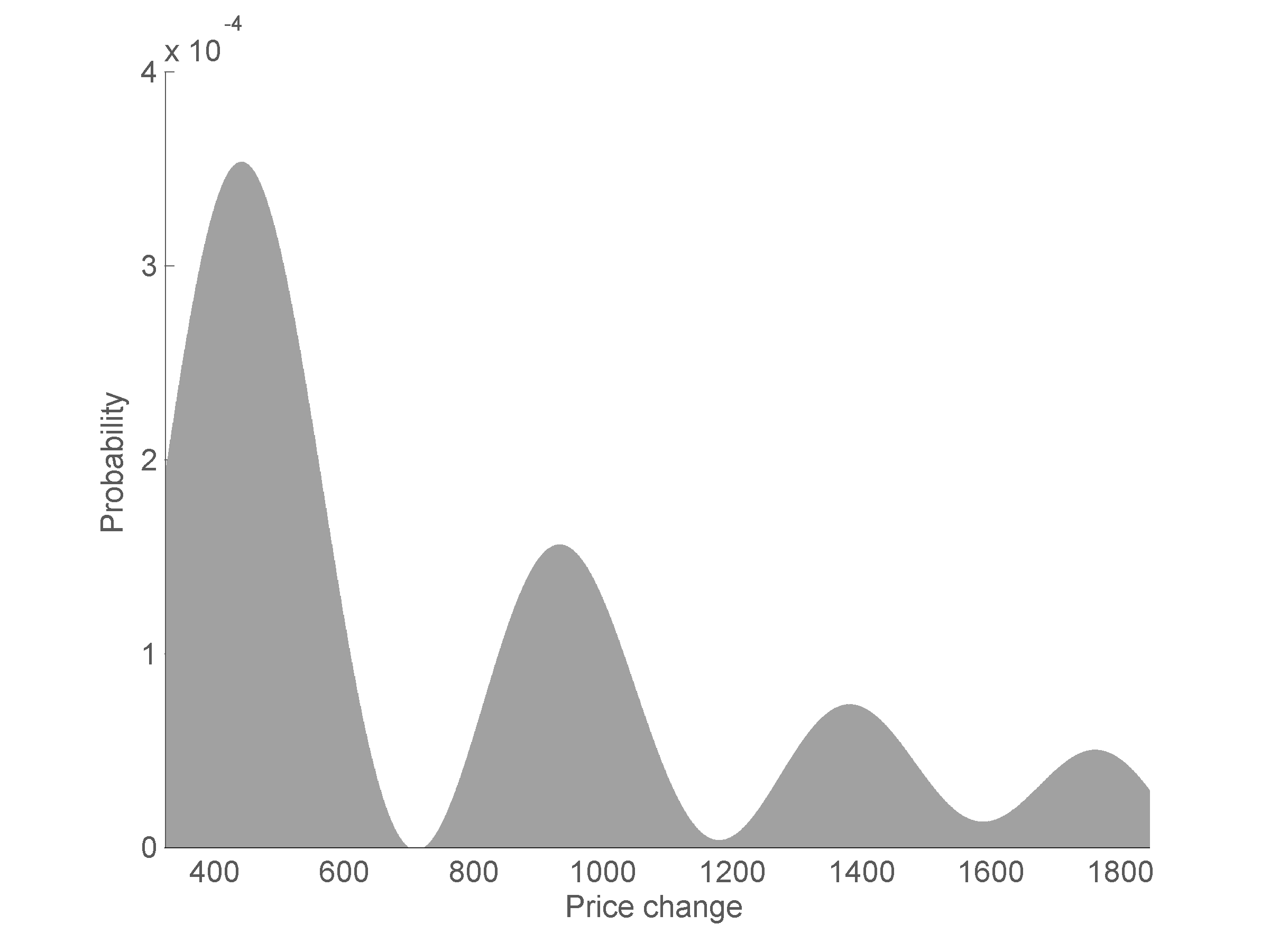
⌘ Scaling The model's solution possesses the property of scalingx—the distribution's structure is kept unchanged when refining the scale, e.g., from 1x (on the left) to 2x (on the right).
|
|
|
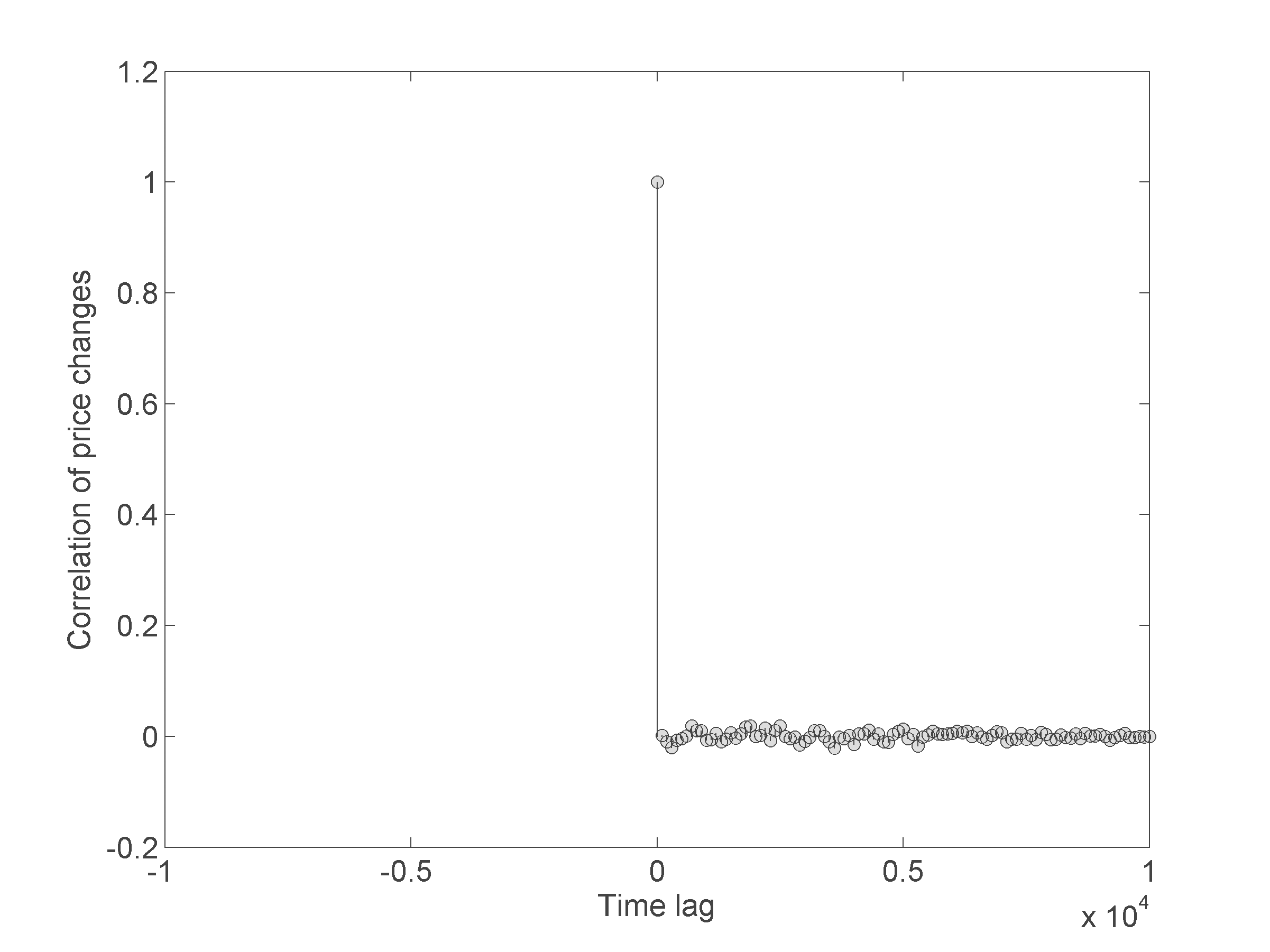
⌘ Nonlinear market memory The solution's asymptotic symmetry clarifies the empirically observed near zero correlation between price changes in real markets—when modelling price changes with the distributions, the simulated autocorrelation function appears to be zero-like (on the left). At the same time, the simulated correlation field between successive price changes evinces a non-random internal structure (on the right), which asserts the presence of nonlinear market memory.x
|
|

|
|
What makes our model qualitatively different from the others is that it naturally appears from the originally formulated first principles rather than is taken a priori. The consistency of this model with market reality may be evidence of our shrewd thinking in discovering the genuine mechanisms of stochastic dynamics in real-world phenomena.
|
|
|
Testing You can perform independent tests with the current version of our model. Please refer to the user guide for making yourself familiar with the online test system. Auxiliary utilities aimed to assist in the analysis of outcomes are available for download as well:
 User guide User guide
 Auxiliary utilities Auxiliary utilities
|
c
|
|
Data analysis and prediction
|
Motivation
During the evolution stochastic dynamical systems pass through a sequence of states characterised by different types of behaviour. A low chaotic behaviour implies gradual and continuous changes of states, whereas a highly chaotic behaviour consists of fast and abrupt alterations. From a practical standpoint the swift change of behaviour from a highly chaotic to a low chaotic regime marks the approaching to a catastrophe, and hence the advance detection of the corresponding time moments is of crucial importance in many applications—examples include the real-time monitoring for the structural integrity of industrial facilities, early detection of disastrous seismic events, diagnostics of diseases, prediction of price crashes in financial markets, just to name a few. The lack of adequate equations of motion for real-world stochastic dynamical systems makes it necessary to recognise the forthcoming of a catastrophe using methods of statistical physics applied to historical records of the system's evolution.
|
|
Goal
The goal of this project is to develop statistical methods of analysis of time series able to recognise the system dynamics typical for precatastrophic states.
|
|
Results
We have developed statistical methods for identification of critical states based on the analysis of various properties of the observable(s) describing a dynamical system. Depending on the mode of evolution, the system is exhibiting different sorts of dynamics, which allows to distinguish precatastrophic and quiet states by quantifying the properties of its observables.
|
|
⌘ Data classification
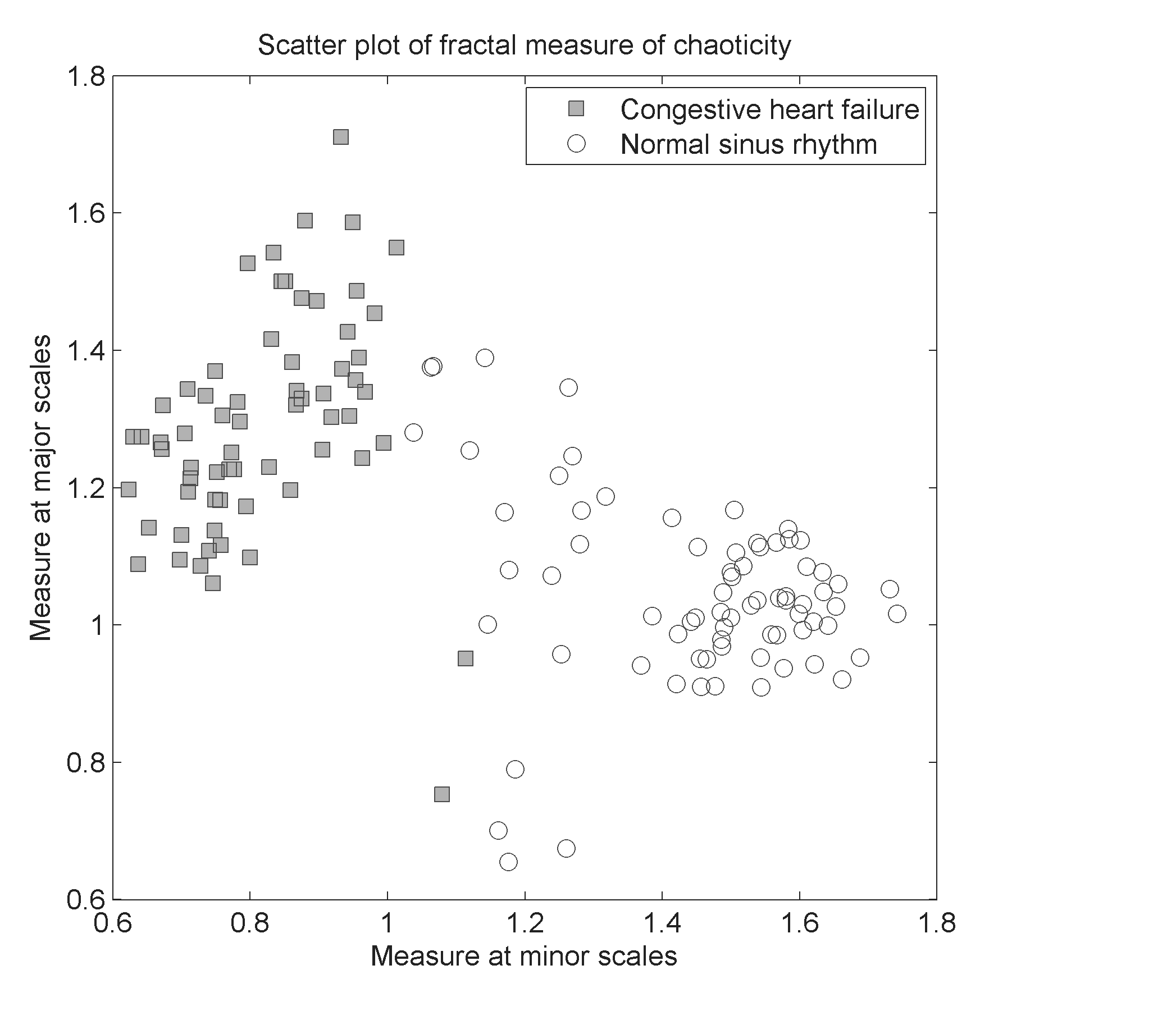
An example of recognition of precatastrophic and quiet states is shown on the right—the two clusters representing healthy and diseased subjects are clearly separated according to the character of behaviour of the heart rhythm.
|
⌘ Discrimination of states
|
|
⌘ Probabilistic forecast of catastrophes

|
⌘ Early detection of catastrophes
For certain applications the results of data classification can be enriched to produce time-dependent maps of hazard that highlight vulnerable parts of the system where a catastrophe is likely to happen. An example on the left shows a map of seismic hazard near the Japanese islands with potentially risky areas where disastrous seismic events may occur in the near future.
|
|
Further reading The results of this research have been published in peer-reviewed journals:
The computer codes implementing some of the developed methods for identification of critical states, along with a presentation on the estimation of seismic hazards using big data analysis, are available for download:
 Computer codesx
Presentation Computer codesx
Presentation
|
|
Other models
Apart from the development of statistical methods originating in physics that imply the quantification of typical hallmarks of catastrophes, for applied projects we have also developed numerous purely mathematical models of artificial intelligence (AI) based on machine/deep learning (ML/DL) methods.
|
|
⌘ Predictive analytics
For a large number of industries, such as automotive, real estate development, retail (including fast-moving consumer goods—FMCGs), tourism and travel, and many others, optimal business planning involves forecasting key economic parameters specific to a particular activity. Such a forecast can be made by analysing previous values of the relevant economic factors and, basing thereon, building AI models of different degrees of complexity.
|
|
Nonlinear vector autoregression
An example on the right illustrates an assessment of total productive maintenance (TPM) using neural networks: a number of key production parameters characterising the efficiency of a business and depending on dozens of exogenous factors are first approximated on the available historical data and then predicted for a certain period of time in the future.
|
Nonlinear vector autoregression

|
|
|
Cointegration

|
Cointegration
An example on the left shows an assessment of a cross-industrial connection between the share prices of hotel and airport companies: despite highly unstable dynamics of the two types of assets, testing a hypothesis of relationship reveals that in some cases the behaviour of one asset can be predicted and profitably traded basing on the monitoring for the dynamics of the other.
|
|
c
|
|
Disorder and self-organisation
Motivation Evolution of any open dynamical system implies a transfer of energy from one place to another via the mechanisms of accumulation and dissipation, which is manifested in self-organisation and disorder processes. If during the evolution the amount of energy occasionally exceeds a critical threshold, the system's dynamics is drastically accelerating that eventually results in a release of energy—a blow-upx occurs. Because in many practical applications (e.g., thermonuclear fusion, deformation and fracture of solids, weather dynamics, among others) the flow of energy can be simulated by nonlinear diffusion-reaction equations, the latter become an important model for studying the evolution of the corresponding dynamical systems.
|
|
Goal
The goal of this project is to develop numerical simulators for modelling nonlinear diffusion-reaction phenomena that evince a blow-up behaviour in complex media.
|
|
Results
We have developed a numerical simulator and modelled several energy flows phenomena in a 3D spherical shell. Click on the images below to watch the corresponding process in dynamics.
|
|
⌘ Combustion
The phenomenon of combustion is characterised by a growth of temperature in a given volume within a finite time. This process is a classical example of evolution towards blow-up. There are three different modes of combustion:
|
|
HS-mode
.png)
|
HS-mode
This mode implies expansion of the area of combustion during the evolution, so that more and more parts of the volume are involved in the process with time.
|
|
LS-mode
This mode implies reduction of the area of combustion during the evolution—the volume is cooling down almost everywhere, except the tiny parts at which the energy is being accumulated. Unlike the HS-mode, here the process is evolving in a quasi-stationary manner, so that the blow-up occurs extremely fast at the very end.
|
LS-mode
.png)
|
|
S-mode
.png)
|
S-mode
This mode is the borderline case between the two shown above: the area of combustion is expanding in the radial direction only, being kept nearly constant in the rest two directions all the time.
|
|
⌘ Temperature waves
Temperature waves are phenomena of energy transfer due to the expansion of the area of thermal diffusion. This process is to some extent similar to combustion in the HS-mode, except that the maximum temperature is not changing and hence the wave front is propagating without a growth or decay of energy.
|
⌘ Temperature waves
.png)
|
|
⌘ Spherical travelling waves
.png)
|
⌘ Spherical travelling waves
Spherical travelling waves provide the energy transfer via an oscillation of sources located on the surface of a sphere. An example on the left shows a multidirectional transfer of energy along the equator depending on the latitude of the source's location.
|
Further reading The results of this study have been presented at a number of scientific conferences on numerical simulation and applications in industry and published in peer-reviewed journals:
|
•
|
Yu.N. Skiba and D.M. Filatov, Numerical Modelling of Nonlinear Diffusion Phenomena on a Sphere,x in: N. Pina et al. (eds.), Advances in Intelligent Systems and Computing 197 (2013) 57-70 (a collection of selected papers of the 1st International Conference on Simulation and Modeling Methodologies, Technologies and Applications (SIMULTECH 2011), Noordwijkerhout, the Netherlands, 29-31 July 2011, at which the study was given the Best Paper Awardx)
|
|
•
|
Yu.N. Skiba and D.M. Filatov, An Efficient Numerical Method for the Solution of Nonlinear Diffusion Equations on a Sphere,x in: A.R. Baswell (ed.), Advances in Mathematics Research, vol. 18, Nova Science Publishers, the USA, 2013, pp. 271-298
|
|
•
|
|
|
•
|
Yu.N. Skiba and D.M. Filatov, Modelling of Combustion and Diverse Blow-Up Regimes in a Spherical Shell,x in: P. Quintela et al. (eds.), Mathematics in Industry 26 (2017) 729-735 (a collection of selected papers of the 19th European Conference on Mathematics for Industry (ECMI 2016), Santiago de Compostela, Spain, 13-17 June 2016)
|
|
•
|
|
The computer codes implementing our models and a presentation on the numerical simulation of energy flows in complex media are available for download:
Computer codesx
Presentation
|
c
|
|
Computational fluid dynamics
Motivation A large number of practically important problems of environmental modelling relates to the propagation of fluids. Typical examples are global and regional atmospheric flows, coastal currents near ports and harbours, river floods, tsunamis. Apart from their importance per se, many of these flows may also be carriers of chemical pollutants propagating in the atmosphere of a city or over the sea surface. Because all fluid flows are governed by a number of physical laws (called conservation lawsx), a proper computational fluid dynamics (CFD) model used in the numerical investigation has to comply with the discrete analogues of the underlying differential conservation laws, otherwise the simulation's outcomes will be inadequate to the real physical phenomena.
|
|
Goal
The goal of this project is to develop numerical simulators that would allow accurate modelling of fluid flows in open and closed domains with irregular boundaries, as well as be capable of modelling the propagation of environmental pollutants and implementing optimal strategies of control of the air and marine environments.
|
|
Results
We have developed several CFD numerical simulators that allow modelling of atmospheric and marine flows in domains of arbitrary shape, as well as implementing various strategies of pollution control. It is essential that our models provide fulfilment of the underlying conservation laws, which ensures both mathematical correctness and physical fidelity of the results of numerical simulation.
|
⌘ Marine flows in irregular shallow basins An example of ocean shallow-water flowsx is shown on the right: we have simulated a wind-driven dynamics in the Venetian Lagoon assuming that an atmospheric vortex over the sea is first rotating clockwise and then changes the direction to anticlockwise.
|
⌘ Marine flows in irregular shallow basins
.png)
|
Further reading The results of these studies have been presented at scientific conferences and published in peer-reviewed journals and collection volumes:
|
•
|
|
|
•
|
Yu.N. Skiba and D.M. Filatov, Fully Discrete Shallow Water Models Conserving the Mass and Total Energy, the 2nd International Conference "From Scientific Computing to Computational Engineering" (IC-SCCE 2006),x Athens, Greece, 5-8 July 2006, p. 45
|
|
•
|
Yu.N. Skiba and D.M. Filatov, On Splitting-Based Mass and Total Energy Conserving Arbitrary Order Shallow-Water Schemes,x Numerical Methods for Partial Differential Equations 23 (2007) 534-552
|
|
•
|
Yu.N. Skiba and D.M. Filatov, Conservative Arbitrary Order Finite Difference Schemes for Shallow-Water Flows,x Journal of Computational and Applied Mathematics 218 (2008) 579-591
|
|
•
|
Yu.N. Skiba and D.M. Filatov, Mass and Energy Conserving Fully Discrete Schemes for the Shallow-Water Equations,x in: G. Spadoni (ed.), Energy Conservation: New Research, Nova Science Publishers, the USA, 2009, pp. 155-197
|
|
•
|
Yu.N. Skiba and D.M. Filatov, On Operator Splitting and Conservative Finite Difference Schemes for the Shallow-Water Equations on Doubly Periodic Manifolds, the 23rd Biennial Numerical Analysis Conference (NA09),x University of Strathclyde, Glasgow, Scotland, the UK, 23-26 June 2009, p. 44
|
|
•
|
|
|
•
|
Yu.N. Skiba and D.M. Filatov, Simulation of Shallow-Water Flows in Complex Bay-like Domains, the 2nd International Conference on Simulation and Modeling Methodologies, Technologies and Applications (SIMULTECH 2012),x Rome, Italy, 28-31 July 2012, pp. 24-31
|
|
•
|
Yu.N. Skiba and D.M. Filatov, Numerical Simulation of Coastal Flows in Open Multiply-Connected Irregular Domains,x in: M.S. Obaidat et al. (eds.), Advances in Intelligent Systems and Computing 256 (2014) 71-84 (a collection of selected papers of the 2nd International Conference on Simulation and Modeling Methodologies, Technologies and Applications (SIMULTECH 2012), Rome, Italy, 28-31 July 2012)
|
|
•
|
|
|
•
|
Yu.N. Skiba, R.C. Cruz-Rodriguez and D.M. Filatov, Solution of the Linear and Nonlinear Advection-Diffusion Problems on a Sphere,x Numerical Methods for Partial Differential Equations 36 (2020) 1922-1937
|
|
c
|
|